Sponsoring a child makes everything more personal. This truth hit home for me when Typhoon Haiyan struck, because my sponsored child lives in the Philippines. I wrote about Mariecris, her fate, and how she’s impacting my family on the Food for the Hungry blog.
5 disturbing barriers that keep kids out of school
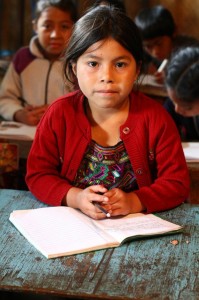 I’m blogging today over at Food for the Hungry about back-to-school season. We take it for granted in the United States that our kids will go to school, but in developing countries, it’s not as easy.
From my experience, I’ve seen five barriers that keep kids from attending school in poor places. To ensure that they get an education, we have to address all five of the barriers.
Check out my list on Food for the Hungry’s blog, and let me know if I’ve missed anything.
Picture your church in the Philippines
Today I’m posting over at FH about the Philippines. Here’s an excerpt.
In Camarines Norte (“cah-mah-REEN-es NOR-tay), over half of the population lives below the poverty line. Children are vulnerable to chronic hunger. They go to school in classrooms that are bursting at the seams, sometimes with class sizes of 60 children or more. It’s common for children to drop out of school at a young age to help provide for their families.
But there’s good news. God has not forgotten the people of Camarines Norte. He has given them tremendous potential! Community leaders are eager to learn and are open to new ideas—particularly so they can improve the lives of their children. Several local churches are actively present and serving. Your church can come alongside these local churches and leaders to change the future for the community.
Please check out the rest of this post on the Food for the Hungry blog!
Free Christmas materials for pastors
Yes, it’s July and I’m talking about Christmas.
No, I don’t approve of Christmas displays at Costco and Target in July.
But YES, I am talking about Christmas because your pastors are talking about Christmas, and that means this is the time for them to hear about Hope Tree!
Here’s an excerpt from today’s blog over at Food for the Hungry.
When your church members sponsor children through your Hope Tree, they’ll enter into relationships with children living in poverty. They’ll know that their support is giving God’s hope to children. And they’ll each receive updates on their child’s progress. They can write to their sponsored children and even visit them!
By placing a Hope Tree in your lobby or sanctuary, you’re providing all of this interaction to your church. As one of your church’s pastors, you don’t have to chase down reports or wonder how the funds are being used. Food for the Hungry takes care of the details.

Please read more on the FH website, and ask your pastor about hosting a Hope Tree!
Best 3 practices for raising generous children
I am always thinking about how to raise my children to be good global citizens even though they are growing up in one of the most hedonistic cultures in today’s world. I haven’t figured it out by any stretch of the imagination, but today on the FH blog I shared three ways that I’m working on it.

The three practices:
- Watch your language.
- Create generous moments.
- Be the example.
Curious? Check out my post on the FH blog.
The First Need of Every Child
Today I’m posting at Food for the Hungry. Hope you’ll check it out.

When my co-workers found Mayra, she was 10 years old. She was living with her parents and her five younger siblings.
If you were to visit Mayra’s home in the neighborhood of Horno Ckasa, Bolivia, you’d first notice the door. We don’t think much about doors where I live in suburban America. We take for granted that we have sturdy front doors with latches and locks. But in a rough neighborhood in Bolivia, Mayra’s door is a danger. It’s made of wood so old that it’s deteriorating, a reminder of the vulnerability that Mayra and her family face every day.
Read more here.
Baking by Weight, Not Volume
It might be hyperbole to say that baking by weight rather than volume has changed my life. But it has certainly changed my life in the kitchen.
When I got into sourdough bread baking a few years ago, I read somewhere that measuring by weight is much more accurate than measuring by volume, especially for flour.
This got me interested, since my usual baking routine went something like this.
- Carefully measure ingredients.
- Bake.
- Blame the cake-like or gooey outcome on how poorly I must have measured the flour.
Now, I have a new routine.
- Convert volume to weight for each ingredient. I write it right on the recipe for future use. Here’s a list of conversions for almost any ingredient.
- Get out the kitchen scale.*
- Place the mixing bowl or bread machine pan on the scale. Tare.
- Pour my ingredients directly into the bowl, taring after each ingredient.
- Bake.
- Feel delighted with the outcome AND the lack of measuring spoons and cups to clean up!
*My scale is actually a 10-year-old postal scale. Any scale with accuracy to 0.01 oz (or 1 g) will work. Look for a scale with a capacity of at least 5 lb (~2 kg).
At first I thought that ingredients of just a teaspoon or two, like salt, wouldn’t measure by weight with sufficient accuracy. But I enjoyed the lack of clean-up with measuring cups so much that I went ahead and tried it with the smaller ingredients too. Everything is turning out well so far!
What do you think? Will baking by weight change your (kitchen) life too?
Saving Her Allowance
My post today over at Food for the Hungry…
My 8-year-old daughter answered the phone with something urgent to tell me.
 “Mom, this girl has worms in her belly,” Linda blurted. I had a moment of panic, wondering what could possibly have happened at home in the 24 hours since I had left town on a trip for work.
“I’m looking at this book, and there’s a picture of a girl with a big belly,” she continued.
Quickly I realized that Linda was looking at the FH gift catalog, which is full of opportunities to help vulnerable children thrive. My panic turned to a smile.
Read the rest at Food for the Hungry >
Three Gifts on Christmas Morning
My post today over at Food for the Hungry…
 When my husband and I reinvented our Christmas celebration a few years ago, we reconsidered gift giving. It was our daughters’ first Christmas after joining our family at ages three and four. We had a blank slate.
It was around this time that a good friend, JoLynn, had told me of her family’s Christmas tradition, which she had borrowed from another friend.
“We give each of our children three gifts at Christmas,” JoLynn informed me, “just as the Wise Men brought three gifts to Jesus.”
Read the rest at Food for the Hungry >
Let Me Surprise You About Orphan Care
Here’s a presentation that I gave on behalf of the Faith to Action Initiative at the Christian Connections in International Health Conference in June.
The topic was “Transforming U.S. Church Values in Orphan Care.” In my own life, both in personal work with foster care and professional work with global poverty, I’ve seen a number of misconceptions about orphan care.
How would you answer these three questions?
- What would you call a facility where orphans should live?
Most people say, “An orphanage.” - How many parents does an orphan have?
Most people say, “None.” - Who does God want to use to help orphans?
Many of us say, “Me!”
None of these answers are quite as simple as they might first appear. Watch the video to learn more.